Along with local politicians, business leaders, many different organizations, and ordinary citizens, Protect the Adirondacks is concerned about the future of Adirondack communities. As in many communities across Rural America, the Adirondack Park population is aging, school enrollments are shrinking, high quality jobs are few, and many communities are experiencing small population declines. A popular explanation for these negative trends in the Adirondacks pins the blame for these realities on environmental protection. Though this claim, that conservation is bad for the economy and bad for people, lacks evidence, it is routinely invoked to justify weakening environmental regulations in the Adirondack Park.
Old misconceptions about the special burden or economic hardships placed on Adirondack communities and residents by environmental protections die hard. Complaints about the supposed harshest environmental rules in New York or the U.S. are often followed by claims about unique negative impacts inflicted on the Adirondack economy and population.
An analysis of 50 years of economic and population trends tells a different story. The reality is far different and far more nuanced than the claims above insist. If there was a distinct negative impact on Adirondack communities as a result of environmental protections from 1970 to 2020, then it would stand to reason that these impacts would be clearly seen in 50-year trends for median household income, per capita income, the poverty rate, employment rates, and population growth. After our investigation of these important economic and population measures, we can say with confidence that there is no discernible negative impact: Adirondack communities have either surpassed or were consistent with rural areas across the United States.
In fact, a strong argument exists for a counter narrative that the Adirondack Park’s relatively stable economic and population position, when compared to other rural areas across the U.S., is due to critical investments in environmental protection that have made the Adirondacks a dynamic rural area where many people desire to visit, own property, and move to as career age adults or retirees.
While this report emphasizes issues that pertain to the economic and social welfare of Adirondack communities and focuses on the rebuttal of the claim that conservation does Adirondack people significant harm, we want to be clear that we do not believe that the justification of conservation in the Adirondacks stands or falls with the success of our position on these matters. There are reasons other than economic ones to conserve wilderness, ranging from aesthetic to spiritual to preserving the integrity of natural systems. We do not address these considerations here, but for many they are primary. What we do show is that we can pursue conservation energetically without harming our friends and neighbors. Indeed, conservation is typically more of an economic asset than a liability.
Figure 1: Adirondack Park Land Use and Development Plan Map, 1973
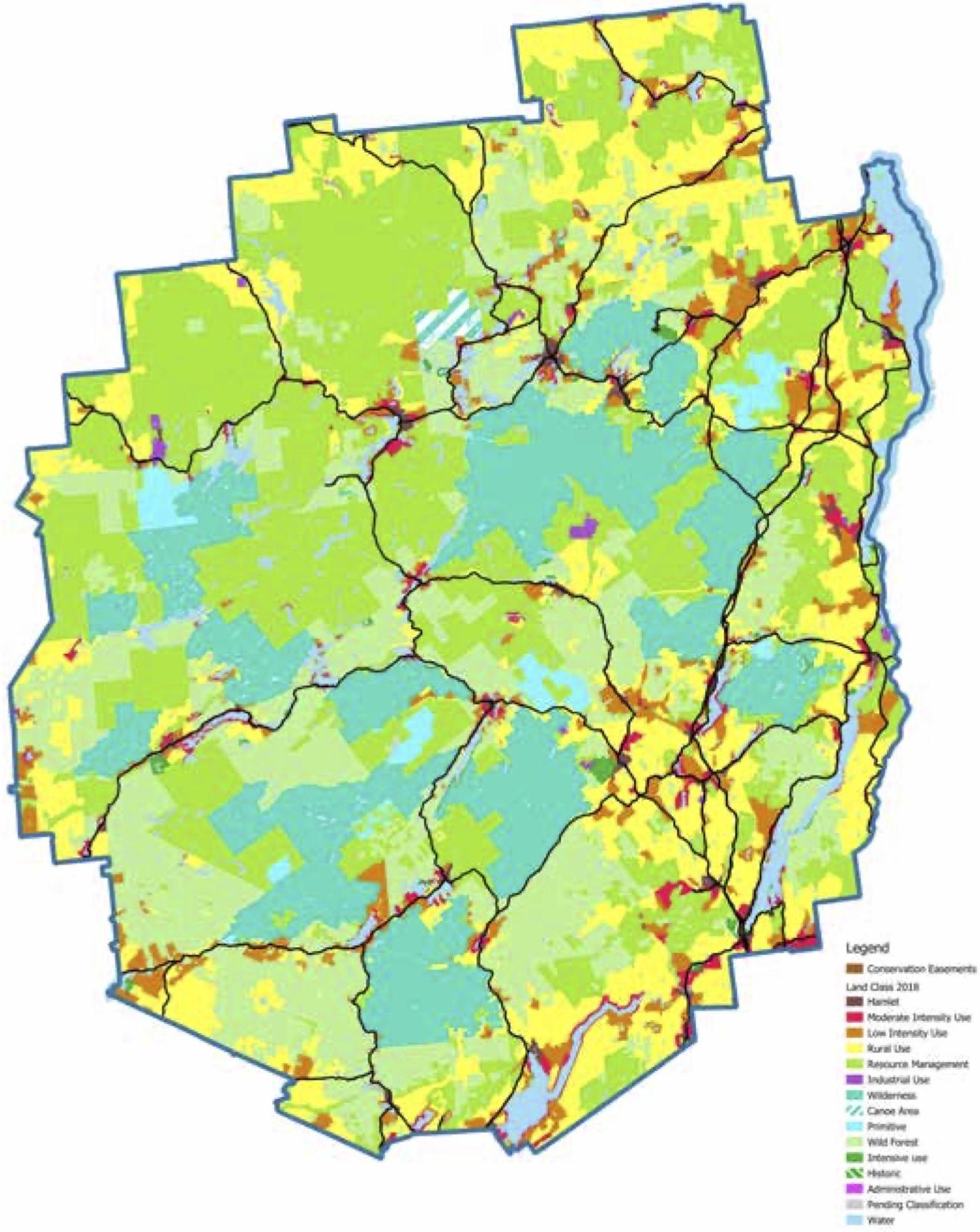
In 1973, there were over 2.1 million acres of Forest Preserve and no large state-owned conservation easements.
Figure 2: Adirondack Park Land Use and Development Plan Map, 2018
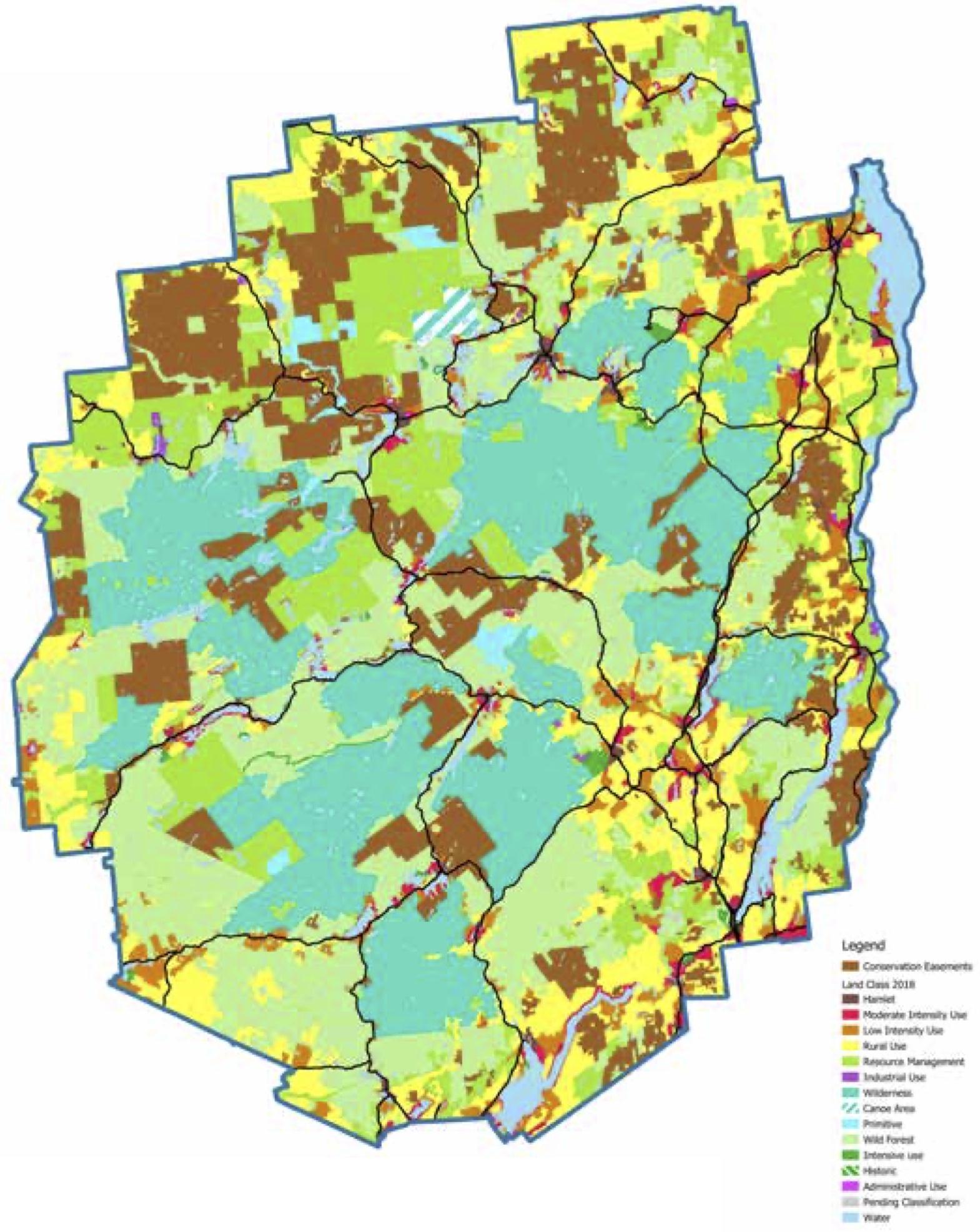
In 2018, there were over 2.6 million acres of Forest Preserve and conservation easements totaled nearly 800,000 acres.
The years between 1970 and 2020 saw dramatic changes in the nature of environmental protection in the Adirondacks. These changes occurred on three fronts: a) the enlargement of the Forest Preserve by purchases of over 400,000 acres; b) the institution of regional land use planning and zoning on private land through the Adirondack Park Agency Act; and c) the protection of nearly 800,000 acres of private land under state-held conservation easements. Do these developments explain an economy that seems stagnant and a population that is aging and contracting? The question we seek to answer in this report is this: Has open-space protection negatively impacted economic and population trends in the Adirondacks during the last half-century?
We approach this question carefully, with detailed analysis of data from the U.S. Census and other sources. If there had been a negative economic or population impact, it would be seen clearly in the data from 1970 to 2020. If negative impacts were evident, they would stand out when Adirondack communities are compared with other areas in New York, the U.S., the rural Northeast, and Rural America. Our analysis concludes that environmental protection has had no discernible negative impact on the Adirondack economy or population. The argument that conservation in all or any of its forms diminishes economic opportunity and drives people out of the Adirondack Park is false and is not supported by a national analysis of economic and population trends.